
In sustainable construction, low-carbon materials are increasingly becoming a cornerstone of responsible design strategies. Investors, developers and general contractors now assess projects not only in terms of cost, durability or aesthetics, but also by their overall impact on the climate.
That is why technical specifications more and more often include requirements related to carbon footprint (GWP – Global Warming Potential), Environmental Product Declarations (EPDs), and compliance with certification systems such as LEED and BREEAM. These systems are no longer just a prestigious add-on — in many countries they have become a practical requirement: a condition for participating in tenders, obtaining financing, or benefiting from preferential tax solutions.
Assessment increasingly covers the full life cycle of a building — from material selection and construction, through operation, all the way to end-of-life. In this approach, materials with low or even negative GWP become critical to achieving climate neutrality (Net Zero Carbon Buildings). In this context, biogenic products gain major importance — i.e., products that naturally bind carbon within their structure. Wood-based materials, including plywood made from certified forest raw material — such as plywood produced by Paged Plywood — are an excellent example of solutions that not only meet the technical requirements of modern construction, but also improve the environmental balance of an investment.
Thanks to an Environmental Product Declaration (EPD), plywood is one of the best environmentally documented building materials. It combines durability, low weight and very good load-bearing capacity with a measurable, positive climate impact. Unlike steel or concrete, which generate CO₂ emissions already at the production stage, wood stores carbon dioxide throughout the building’s service life and, at the end of its life cycle, can be reused or recovered through energy recycling.
At a time of rising ESG requirements, plywood with an EPD is no longer a niche choice. Today it is a tool that helps construction companies design the buildings of the future — low-emission, certified and environmentally friendly. For Paged Plywood, this means the consistent development of a plywood offering aligned with these requirements.
Research conducted by Bureau Veritas Polska for the State Forests National Forest Holding “Lasy Państwowe” indicates that the total average carbon footprint of 1 m³ of wood is approximately 7 kg CO₂e (CO₂e = carbon dioxide equivalent, i.e., different greenhouse gases converted to a common “CO₂” metric).
The methodology covered the full life cycle of wood “from cradle to gate” — from the moment a seedling is produced, through its several-decade growth, to the point when the raw material is prepared to leave the forest and the area is made ready for new planting.
The result of 7 kg CO₂e/m³ is an average for a product group: pine, spruce, fir, beech, oak, alder and birch. The result is even more favorable for two species that are among the most common raw materials used in Paged Plywood production:
The highest carbon footprint was recorded for oak — approx. 16.1 kg CO₂e/m³, and lower for beech — 11.86 kg CO₂e/m³. Even in the case of species with a higher footprint than the average, the overall balance remains beneficial — trees growing for decades absorb far more CO₂ than the emissions associated with forest management. This result demonstrates sustainable forest management in Poland and proves that wood is not only a natural and renewable raw material, but also a low-emission one.
In 2024, emissions related to the sale of pine wood were calculated at approx. 913 thousand tonnes of CO₂, while absorption by forests reached 274 million tonnes of CO₂. A difference of three orders of magnitude shows that Polish forests act as a giant “carbon store”, and that the wide use of wood raw material as a substitute for high-emission materials is a major opportunity to reduce emissions and support climate-beneficial actions.
An EPD is a report verified by an independent body that describes — in numerical and comparable form — a product’s environmental impact across its full life cycle: from raw material extraction, through production and transport, the use phase, and end-of-life (in line with LCA – Life Cycle Assessment principles).
For a manufacturer such as Paged Plywood, it is the result of detailed analysis and an investment in transparency. For a construction company, it is hard evidence that the material used truly has a low or negative carbon footprint — and is not merely an effect of “greenwashing”, i.e., unsubstantiated “eco” claims.
The analysis covers the full production cycle, resource consumption (and their carbon footprints) including wood sourced from forests, as well as associated energy and fuel use for operations and transport:
In Paged Plywood’s plywood production process, high-quality large-dimension wood arrives at the plant, such as long logs or stems. The entire raw material undergoes hydrothermal treatment aimed at plasticizing the wood, relaxing internal stresses and reducing cutting resistance. Hydrothermal treatment is carried out in cooking basins or cooking chambers at a temperature of 40–60°C depending on the wood species. The cooking time depends on the season, species and wood diameter and ranges from approx. 30 hours for birch, alder and pine to as much as 72 hours for beech. The logs are then debarked and cut into bolts.

A bolt is transported to a rotary lathe. After centric mounting in the machine, it is set into rotational motion. A peeling knife, moving in a straight line in the horizontal plane, cuts a layer from the bolt, producing a long ribbon of so-called wood veneer. The thickness of the obtained veneer is typically 1.5 mm for hardwood plywood and 1.5 mm or 2.6 mm for softwood plywood. The veneer is then automatically cut into sheets of the required width.

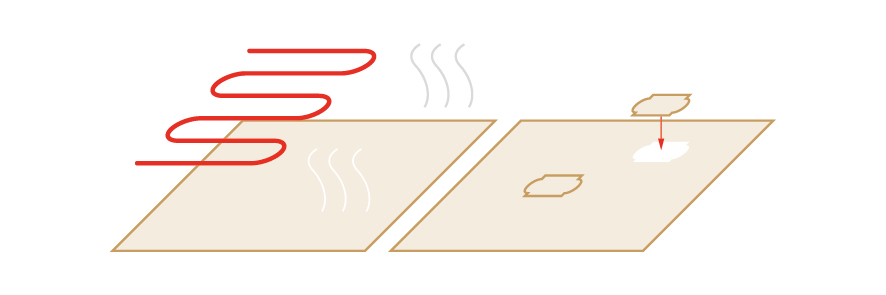
The obtained veneer with a moisture content of 30–120% is dried in roller dryers at 160–180°C to reach a final moisture content of approx. 4–7%. Veneer with defects resulting from wood anatomy (e.g., knots) is repaired by removing defective areas and inserting defect-free veneer patches or wedges with matched color and grain, ensuring high final product quality.
Building plywood lay-ups at Paged Plywood consists of selecting and arranging veneer sheets appropriately. Depending on product application and customer requirements, sheets are arranged crosswise, crosswise-parallel or parallel to each other. Adhesive is applied on both sides to every second veneer sheet, and the adhesive type determines the bonding class.
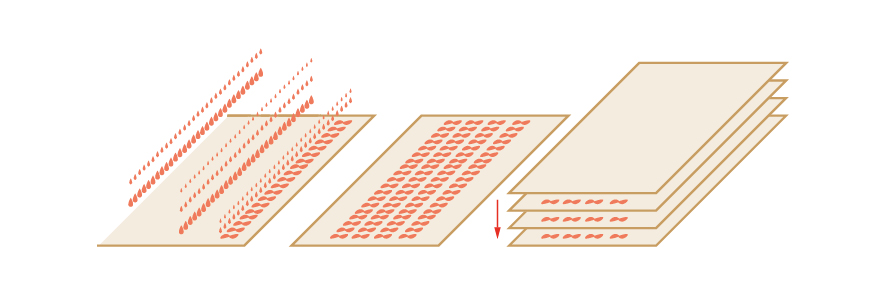
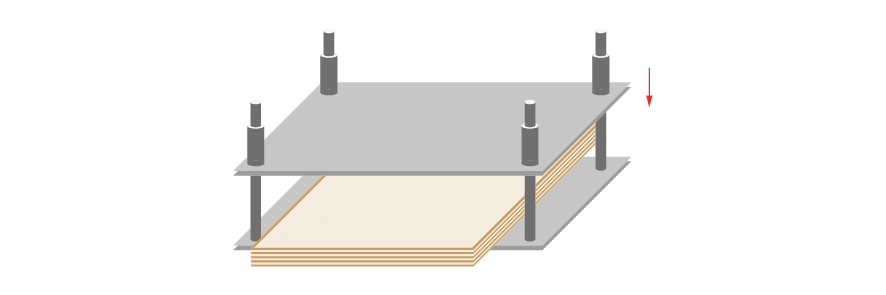
Veneer lay-ups are hot-pressed under high pressure in multi-daylight hydraulic presses. Pressing ensures a durable and uniform bond, guaranteeing that the plywood panel has a consistent internal structure and meets the highest quality standards.
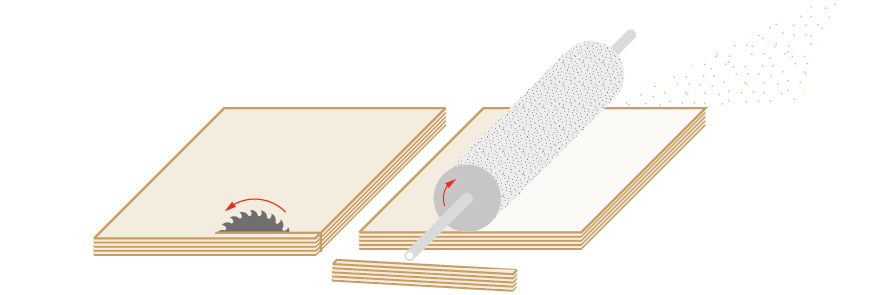
After conditioning, Paged Plywood plywood is processed in finishing operations. This includes trimming edges to standard dimensions using specialized formatting machines, and calibrating and smoothing the surface on automatic calibrating sanders.
The overlaying process is carried out under high pressure and high temperature, giving the plywood new functional properties aligned with the requirements of the specific end use. As a result, Paged Plywood plywood achieves excellent technical and aesthetic parameters.
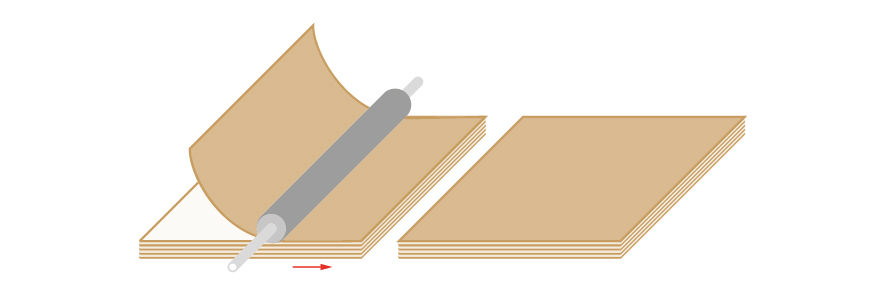
The final step is sorting, during which Paged Plywood plywood is classified by quality according to standards or customer-agreed specifications. This process ensures each sheet meets the highest quality standards and is ready for use in demanding projects.

In practice, EPD has become a document supporting everyday work:
For a contractor, this means that selecting plywood with an EPD from Paged Plywood’s offering can realistically contribute to a higher building certification level — and thus to higher market value and attractiveness to tenants and financing institutions.
Plywood with an Environmental Product Declaration (EPD) is among the most effective materials for earning points in LEED and BREEAM green building certification systems. Its advantage lies in combining three key attributes: low carbon footprint, documented life cycle analysis (LCA), and responsible sourcing of raw materials.
In LEED, plywood with an EPD — such as products from Paged Plywood’s portfolio — helps earn points in the Materials & Resources (MR) category, particularly within Environmental Product Declarations (MRc2). This area rewards the use of building materials that have a verified EPD confirming their environmental impact across the full life cycle. LEED also promotes responsible sourcing. The use of FSC® or PEFC certified wood (used to produce plywood) can deliver additional points. As a result, one material can support multiple assessment areas at once, increasing the project’s total score and helping achieve a higher certification level such as LEED Gold or Platinum.
In BREEAM International New Construction, plywood with an EPD aligns with the Mat 01 – Life Cycle Impacts category, one of the most important certification areas. The environmental impact of materials across the building’s life cycle is assessed here using EPD data. Like LEED, BREEAM also rewards responsible sourcing. FSC® or PEFC certified wood helps meet additional requirements, translating into extra credits and a better final project score. In practice, choosing Paged Plywood plywood with an EPD and FSC®/PEFC certificates can significantly affect scoring in LEED and BREEAM, facilitating a higher certification level and supporting climate goals and ESG reporting.
One of the key topics in the decarbonization of construction is the difference between structural materials. Wood-based products perform exceptionally well compared to aluminium, steel or concrete. This results from production technology, but above all from the raw material used. Wood’s biological ability to absorb and store CO₂ is a key reason why materials such as plywood have an advantage over products whose manufacture begins with energy-intensive raw material production.
Per 1 m³ of material, typical values (modules A1–A3, i.e., “cradle-to-gate”) are as follows:
At the same time, wood in 1 m³ of plywood stores approx. 650–700 kg CO₂e/m³. Plywood therefore stores more carbon dioxide than it generates during manufacturing.
Replacing part of steel-and-concrete structures with wood-based elements such as plywood or CLT can reduce a building’s carbon footprint by even several dozen percent compared with solutions based solely on concrete and steel — as confirmed by many LCA comparisons for mass-timber vs. reinforced concrete buildings.
Carbon footprint is only one of several climate benefits. Plywood production is less energy-intensive than aluminium or steel production. Biomass by-products are used to generate energy in the plywood industry. The material enables prefabrication, shortening construction time. The resulting elements are relatively lightweight, which positively affects transport emissions. Using plywood can also benefit the thermal insulation performance of building envelopes.
For investors and designers, this means not only a lower environmental footprint but also real operational savings and easier compliance with the EPBD directive and the EU Taxonomy, which promote buildings with reduced emissions across the full life cycle.
Paged Plywood plywood with an EPD and a favorable carbon footprint balance is not merely an “eco substitute” for traditional materials, but a strategic tool for construction companies that want to genuinely reduce emissions across the life cycle of their projects. Its use helps improve results in LEED and BREEAM, strengthens ESG strategy execution and supports building an organization’s image as a leader in sustainable construction.
However, an important fact is not included in the information above: biogenic carbon in wood. 1 m³ of wood contains approx. 250–300 kg of carbon, which corresponds to 900–1100 kg of CO₂ stored from the atmosphere. If the panel is used for a long time, this carbon is kept out of circulation — in a sense, building with wood stores CO₂ in buildings. Some plywood producers state that their panels store approx. 650–700 kg CO₂/m³, making them potentially carbon-negative materials. Of course, this approach depends on assumptions (standard LCA usually reports a positive balance because it counts only production emissions). Nevertheless, it is a fact that choosing plywood instead of mineral or metal materials significantly reduces a building’s carbon footprint. Companies focused on sustainable development often promote the use of plywood or other wood-based panels with FSC or PEFC certifications, guaranteeing that the wood comes from legal, renewable sources. Plywood offcuts are often used, for example, as fuel to heat the factory, so nothing is wasted — which aligns with the circular economy concept.
For Paged Plywood and Paged Trade, this is the direction in which we are developing our offering — so that plywood not only meets structural requirements, but also improves the climate performance and market value of every investment in which it is used.