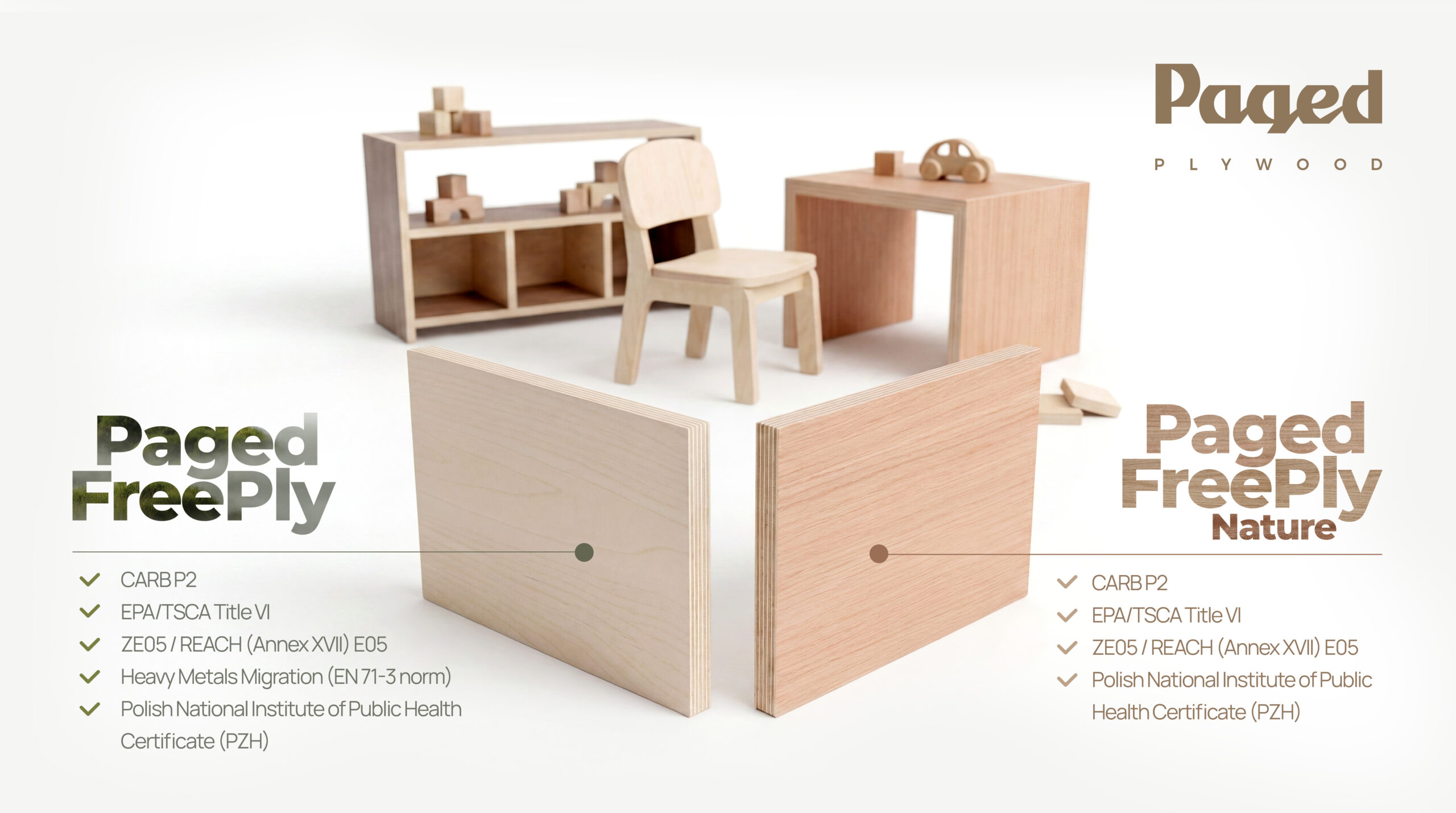
Morąg, 27 April 2026 – Along with tightening regulations concerning formaldehyde emissions and the safety of wood-based materials, manufacturers operating on international markets are increasingly facing the necessity to adapt one product to many legal systems at the same time. This concerns in particular the furniture industry, interior equipment and products having direct contact with the user. Paged FreePly is a plywood produced on the basis of a formaldehyde-free adhesive, which constitutes the foundation of its environmental parameters and allows achieving required emission levels while maintaining high performance properties.
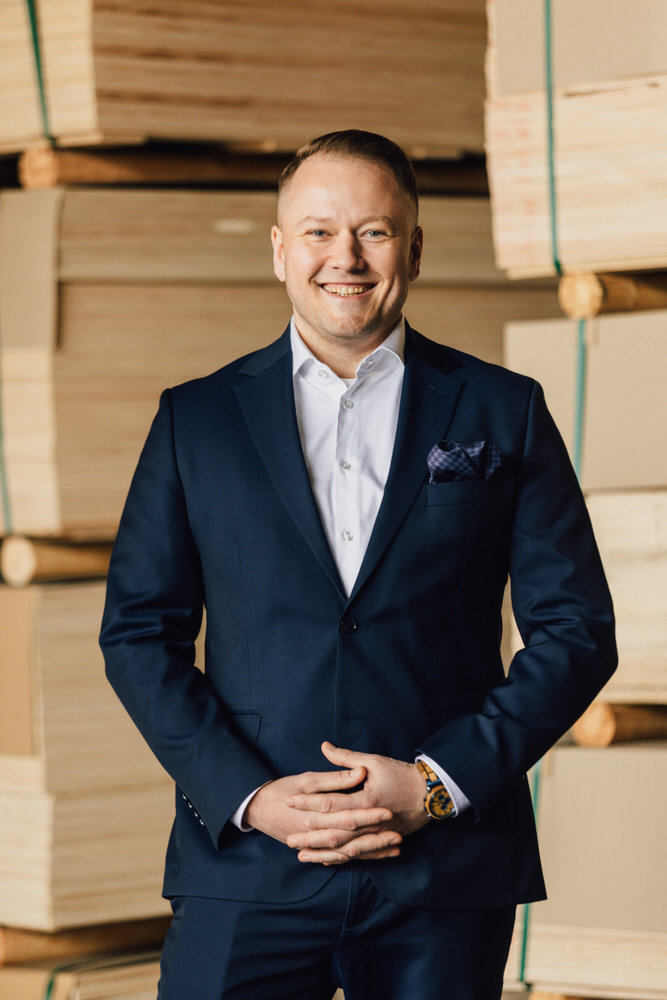
„For our customers it is today key not only how the material looks and what technical parameters it has, but also whether it allows them to safely operate on different markets at the same time. Paged FreePly simplifies this process and thanks to obtained certification gives certainty of regulatory compliance, allowing to focus on the development of the final product.”
Introduced by Paged Plywood at the end of 2025, Paged FreePly plywood was designed exactly in this context as a material whose low emission and safety of use are confirmed on the basis of key certification systems applicable on the most important markets.
In the case of the United States, this means compliance both with the Californian system CARB Phase 2 and federal regulations EPA/TSCA Title VI. Both systems define the maximum level of formaldehyde emissions for wood-based products at the level of 0.05 ppm and are a condition for placing products on the American market – from furniture, through interior equipment elements, to components used in serial production.
At the same time, Paged FreePly responds to regulatory changes in Europe. The product meets the requirements of the German ZE05 standard, as well as the new E05 emission level under the REACH regulation (Annex XVII), which from August 2026 will become applicable in the entire European Union. The new regulations mean a significant tightening of formaldehyde emission limits – their level is reduced by half compared to the current E1 standard.
An important complement to this compliance are also requirements concerning safety of use. Paged FreePly meets the EN 71-3 norm concerning migration of heavy metals, which is of key importance in the case of products intended for children or having direct contact with the user. Additionally, the material has the certificate of the Polish National Institute of Hygiene, which is often required in construction investments and projects carried out in public spaces.
Key certifications in the field of formaldehyde emissions and compliance with regulations of the American and European markets are also held by the variant Paged FreePly Nature, that is plywood Paged FreePly in natural veneer (CARB, EPA/TSCA Title VI, ZE05 and REACH, PZH certificate). Thanks to this it is possible to combine high environmental and regulatory requirements with aesthetic values of the material.
The combination of these certifications in one product has a practical dimension. For manufacturers it means simplification of design and logistics processes – the possibility of using one material in different product lines and on many markets without the need to adjust the raw material each time to local regulations. From the perspective of final sales, this translates into easier placing of products on the market, greater transparency and reduction of regulatory risk.
Paged FreePly finds application primarily in industries where requirements concerning emissions and safety are particularly high – in furniture industry (including children’s furniture), interior and fit-out projects, public space equipment, as well as in production of elements with increased hygienic requirements.
The introduction of Paged FreePly fits into the broader direction of changes in the wood-based materials market, where regulatory compliance ceases to be only a formal requirement and becomes an element of real competitive advantage.
CARB Phase 2 (CARB P2)
The CARB certificate (California Air Resources Board) is one of the most restrictive systems regulating formaldehyde emissions from wood-based products in the world. It applies in the state of California, but in practice constitutes a benchmark for the entire American market.
EPA / TSCA Title VI
These are federal regulations applicable throughout the United States, constituting an extension of CARB standards at the national level.
ZE05 / REACH (Annex XVII – E05)
A new, more stringent level of formaldehyde emissions for the European market, which will become applicable throughout the EU from 6 August 2026.
These three standards (CARB P2, EPA TSCA Title VI and E05) currently constitute the key set of requirements enabling the use of plywood in the furniture industry both in the USA and in Europe.
Heavy metals migration – EN 71-3
The EN 71-3 norm concerns the safety of materials used in the production of toys.
PZH Certificate (hygienic certificate)
A Polish certificate confirming the health safety of materials.
Paged on YouTube: https://www.youtube.com/channel/UCyK3RLmZv1dTicvjpPhbH0Q
Paged on LinkedIn: https://www.linkedin.com/company/pagedplywood/
Paged on Facebook: https://www.facebook.com/pagedplywood/
Paged on Instagram: https://www.instagram.com/paged_plywood?igsh=cGRseWp6cG9yNjZ1
About PAGED Plywood S.A.:
Founded over 100 years ago, PAGED Plywood S.A. is currently one of the largest plywood manufacturers in the European Union. It employs approximately 1700 people and has a total of five production plants in Poland and Estonia. It offers innovative solutions and products that are used in many industries, such as interior design and furnishing, construction, transport and packaging, in over 40 markets worldwide. Since 2019, Paged has been developing and implementing technological and product innovations based on the unique competencies of its own research and development centre Paged LabTech. PAGED Plywood S.A. is part of the Thumos Group, a private Polish industrial and investment consortium.
www.pagedplywood.com
Contact: Magdalena Kicińska, magdalena.kicinska@pagedplywood.com, tel.: +48 725 520 874